lovegobuy Nike Casual Shoe Sizing Guide
lovegobuy Nike Casual Shoe Sizing Guide
lovegobuy Nike Casual Shoe Sizing Guide
If you're planning to pick Nike casual shoes on lovego-buy.net, the first thing to sort out isn't "buy a size up or down," but to confirm what size evidence the page provides. This article is for buyers who are filtering Nike casual shoes but can't judge fit from images alone.
After reading, you should be able to do three things: measure your foot length and width; distinguish between brand size charts, product labels, and insole measurements; and hold off on ordering or ask the platform first when evidence is insufficient.
This article does not apply to those needing medical orthotics, severe foot asymmetry, or professional last assessment. Shoe pages, inventory, prices, and specific size information may change. The information verification date for the platform catalog covered in this article is October 1, 2026.
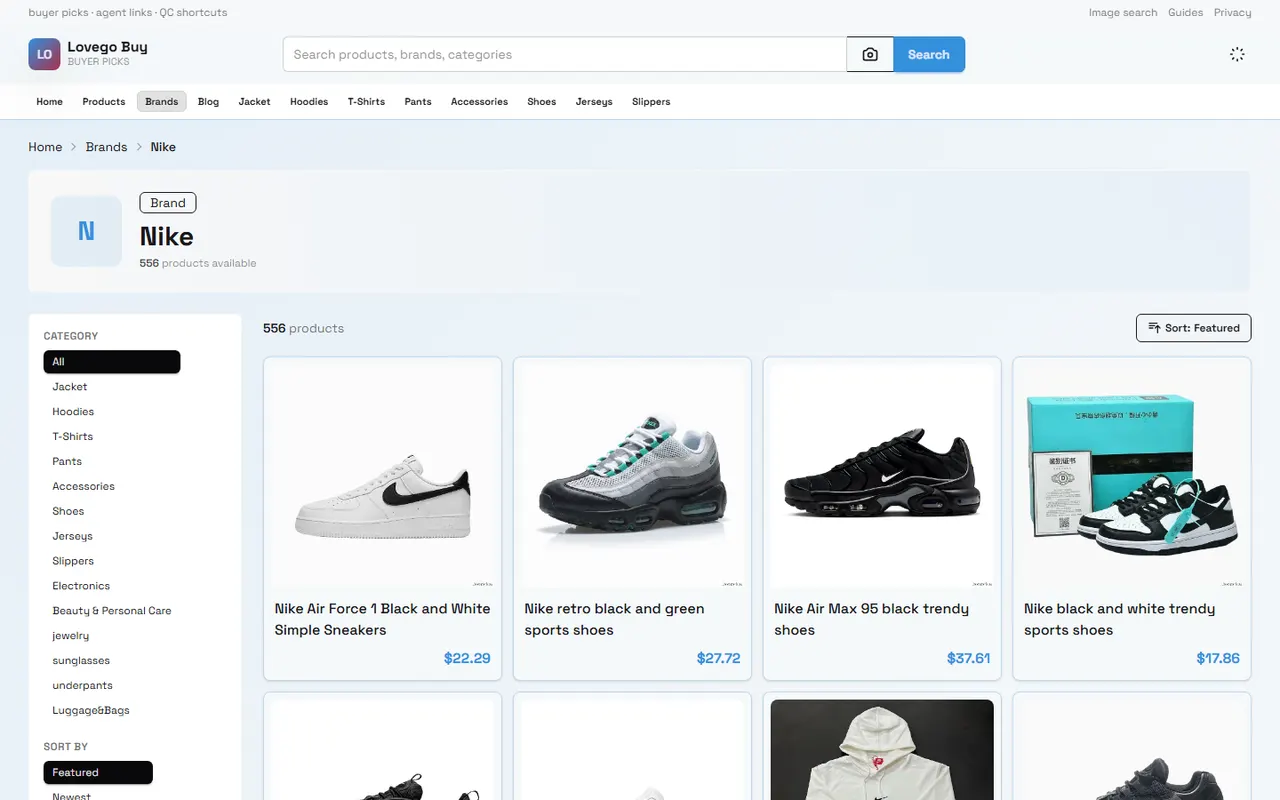
Image: Verification screenshot of the Nike brand catalog page on lovego-buy.net.
Clarify the Casual Shoe Size Verification Task
For Nike casual shoes, size selection requires at least checking foot length, foot width, instep height, and toe box shape simultaneously. Relying only on your usual numeric size can overlook internal space differences between different shoe models.
Before ordering, clarify your actual goals:
For daily wear, prioritize toe room and long-walk comfort.
For a relaxed fit, confirm upper wrap, toe box width, and lace adjustment range.
If pairing with thick socks, include sock thickness in foot length and internal space assessment.
If buying a specific retro or sporty look, don't infer last width from appearance alone.
An actionable size conclusion should answer: your foot length and width; whether the product page provides the corresponding size; whether insole length has actual measurements; and what to ask next if information is insufficient.
Nike Information Confirmable on lovegobuy Pages
As of the verification date, the Nike brand catalog on lovego-buy.net shows 556 items, filterable by categories like Jacket, Hoodies, T-Shirts, Pants, Accessories, Shoes. The catalog includes various Nike shoe names such as Air Force 1, Air Max 95, Air Max 90, Dunk, and Air Jordan 1.
The catalog page helps confirm the rough shoe type, but it cannot replace the size evidence on the specific product detail page. Product names and prices shown in the catalog are page snapshot information; prices, inventory, and page status may change, and they are not sufficient to prove the actual insole length, last width, or wear feel of a particular pair.
Therefore, after seeing a Nike model, you should further check the following on the specific product page:
Whether clear size options are available.
Which size standard is used, e.g., US, EU, or other.
Whether a foot length correspondence table is provided.
Whether actual insole length measurements are provided.
Whether upper material, toe box shape, or fit tendency is explained.
Whether real images or QC information for different sizes exist.
If the product page only has a name, main image, and price, with no size chart or measured information, you cannot treat common brand size experience as a definite conclusion for that product.
Compare Foot Length, Foot Width, and Toe Box Space
It's recommended to measure in the afternoon or evening, as feet are usually slightly larger after prolonged standing than in the morning. Wear the socks you plan to pair with, stand with one foot on paper, measure foot length from heel to longest toe, then measure foot width at the widest part of the forefoot. Measure both feet separately and use the larger result as the screening baseline.
When recording, don't just write "usually wear size 42." Instead, record "left foot length, right foot length, wider foot width, sock thickness." If your longest toe is not the big toe, measure to the actual longest point.
Item to check | Your record | Product page requirement |
|---|---|---|
Foot length | Use the longer foot | Has foot length to size correspondence |
Foot width | Use the wider foot | Has width, last, or toe box explanation preferred |
Toe space | Allow room in front of longest toe when standing | Need to judge via insole length or toe box images |
Sock thickness | Thin, medium, or thick socks | Cannot ignore wearing scenario |
Instep height | Low, normal, or high | Pay attention to tongue, laces, and collar wrap |
Insole length cannot be simply equated to foot length. The shoe needs extra space for toe movement and foot sliding forward during walking, but too much allowance may cause heel slippage. For those with wide feet or high instep, correct length does not mean correct width.
Distinguish Brand Size Charts from Product Measured Info
Size charts are usually standard conversion information provided by the brand or seller, suitable for establishing an initial screening range; product measurements are closer to the actual internal dimensions of a particular pair, but may be affected by measurement position, whether the insole is removed, and measuring tools.
Keep the two types of information separate:
Brand size chart: answers what foot length range a certain size typically corresponds to.
Product label: answers which size standard is selected on the current page.
Insole measurement: answers the approximate insole or internal space length of this product.
Image clues: help judge the shape of toe box, upper, and collar, but cannot replace dimension measurement.
If the brand size chart differs from product measurements, prioritize confirming the measured object, measurement method, and size unit. Do not treat the insole length provided by the seller as directly equivalent to usable internal length, and do not apply experience from one Air Force 1 to Air Max, Dunk, or other models.
Find Fit Clues from Upper, Sole, and Collar Images
Product images provide auxiliary clues but cannot prove wear effect. When examining images, observe the following areas:
Toe box: see if the outline is round, narrow, or noticeably upturned.
Upper: see if the lace hole range is sufficient to adjust wrap.
Collar: see if the heel opening and collar might press on the ankle.
Sole: see if the sole outline is noticeably wider than the upper, as an external contour reference.
Insole or size tag: if the page provides clear close-ups, check for readable size information.
These observations only help you formulate verification questions; they don't let you conclude from images that something is "definitely comfortable," "definitely runs large," or "suitable for wide feet." Especially flat lays, angled shots, and rendered images cannot fully reflect internal space.
If the page has QC images, focus on whether the size tag, insole length, and shoebox label are clear and readable, and confirm that the images correspond to the current order or product, rather than using images of other products as evidence for this shoe.
Size Trade-offs for Different Wearing Scenarios
Daily wear usually requires balancing standing, walking, and sock thickness. In this case, buyers should prioritize confirming toe room, whether the heel slips easily, and whether the laces can securely hold the instep.
If mainly for short-term styling or indoor wear, appearance and upper wrap may be more important, but foot width cannot be ignored. Toe compression may not be noticeable in short try-ons but can become uncomfortable during long walks.
If planning to wear in colder environments, include thicker socks in measurements. If the shoe page lacks insole length, width, or usable QC information, arbitrarily sizing up may increase heel slippage, while sizing down may compress toes. The safest action is to gather more evidence rather than mechanically adding or subtracting a size.
When to Hold Off Ordering Due to Missing Evidence
Consider pausing the order in the following situations:
The page has no clear size unit.
Only EU or US numbers without foot length correspondence.
Only catalog cards without specific product details.
No insole length, insole measurement, or readable size tag images.
Product name does not match the shoe model in images.
No indication whether images are for the current product.
You have notably wide feet, high instep, or left-right foot differences, but no width info on the page.
You need thick socks but only have thin upper images without internal dimension basis.
When asking the platform or seller, don't just ask "Does this shoe run large?" More effective questions: Please confirm the selected size standard, corresponding foot length, insole measured length, toe box width, measurement method, and whether the images and size info correspond to the current product.
If you need to send order or QC screenshots, cover your name, address, phone number, payment info, and full order number, keeping only the product info needed for size judgment. 🛡️
Pre-Order Size Review Checklist
Before ordering, review in the following order:
Measure both feet' length and width, record the larger result.
Record planned sock thickness and primary usage scenario.
Confirm the product detail page, not just the Nike brand catalog.
Confirm size standard and foot length correspondence.
Look for current product's insole length, insole measurement, or clear QC size images.
Combine toe box, upper, and collar images to assess potential space limitations.
Check wrap risk against foot width and instep height.
Ask the platform specific questions about missing information.
Save date records of size charts, product pages, and inquiry replies.
Hold off payment when evidence is insufficient, left-right foot difference is significant, or return/exchange terms are unclear.
The final judgment should be based on your foot measurements and current product evidence, not on fixed notions like "same brand is all the same" or "casual shoes size up." 📏
Conclusion
The Nike brand catalog on lovego-buy.net helps you discover different shoe models, but catalog information alone is insufficient for size decisions. What truly needs checking is the specific product's size standard, foot length correspondence, insole measured info, toe box space, and current product images.
For buyers with normal foot shape, complete page evidence, and clear size units, comparing item by item based on measurements is usually more effective. For those with wide feet, high instep, significant left-right differences, or products lacking internal size evidence, asking and saving replies is more appropriate.
This may add some verification time but can reduce return/exchange, additional shipping, or waiting costs due to size mismatch. If the page cannot provide sufficient evidence, it is not advisable to order directly based solely on brand name, price, or appearance images. ✅
Browse our latest products and find your next favorite item.