lovegobuy Linen Shirt Spreadsheet Guide
lovegobuy Linen Shirt Spreadsheet Guide
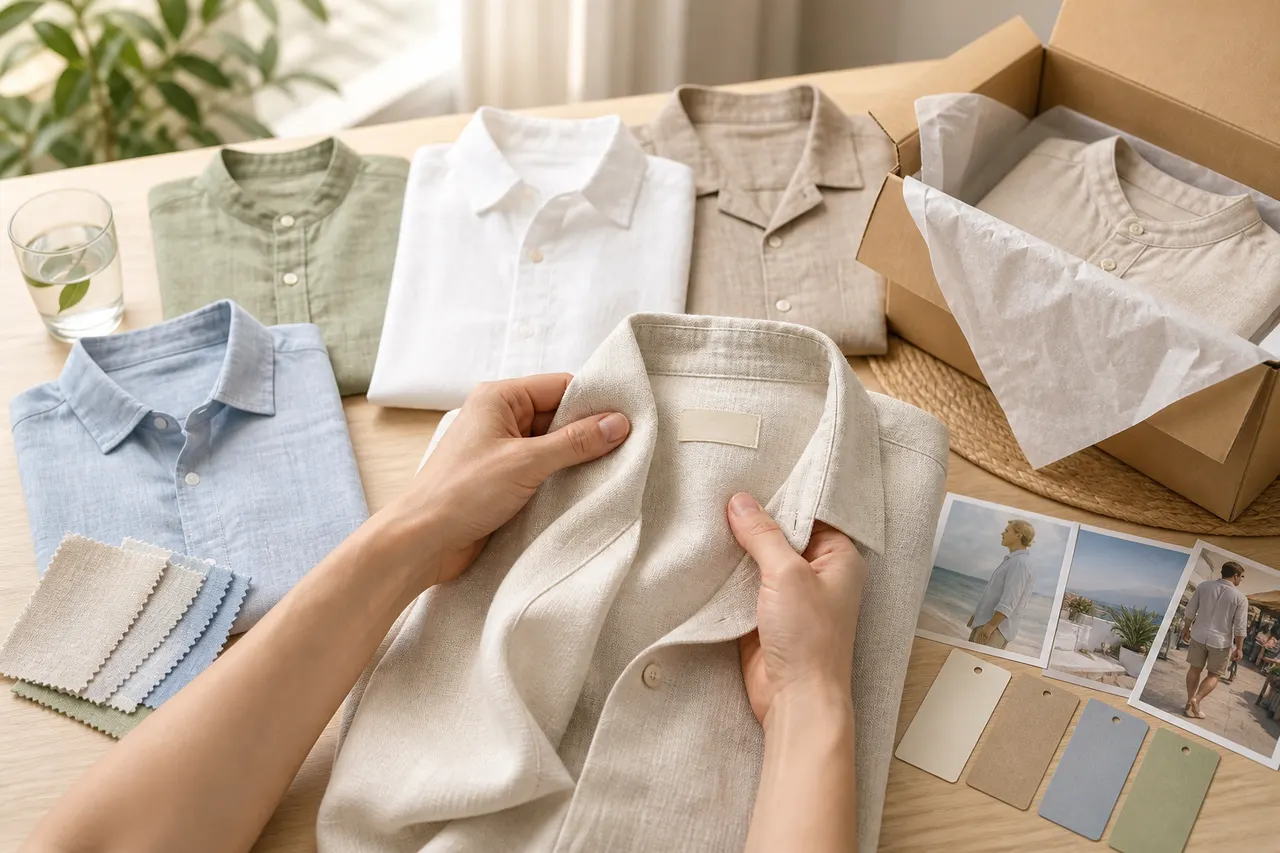
lovegobuy Spreadsheet is useful for discovering and organizing candidate products, but the names, images, and categories in the spreadsheet do not equate to product quality certification. This guide helps you complete linen shirt candidate screening, size verification, and QC checks based on the visible product information on lovego-buy.net, and then decide whether to place an order.
Verification date: August 27, 2026. The current writing materials do not provide individually verifiable product samples, real-time prices, inventory, material certifications, seller return/exchange terms, or international route quotes, so this article does not recommend specific styles, nor does it treat spreadsheet labels as confirmed facts. Prices, inventory, link status, shipping costs, taxes, and platform rules still need to be re-checked before submitting an order.
First determine commuting, travel, or daily wear needs
First choose a primary scenario, don't just add to cart when you see "linen." Whether a linen shirt is suitable depends on the fit, transparency, care requirements, and actual environment, not just the fabric name.
Commuting: Prioritize checking whether the collar is stable, the placket is flat, the length can be tucked into trousers, and whether light-colored styles require an inner layer.
Travel: Focus on wrinkle resistance, drying conditions after washing, luggage volume, and convenience of repeated wear.
Daily casual: Can accept looser drop shoulders or Cuban collars, but still check armholes, chest width, and length to avoid mistaking "oversized" for a true relaxed fit.
High-temperature outdoor: Don't judge coolness solely by "natural fabric"; fabric weight, weave density, color, and blend ratio all affect comfort.
If you need wrinkle-free formal effects, strict uniform business attire, or do not have the conditions to check fiber content labels and garment measurements, this spreadsheet screening method is not suitable for directly supporting an order.
What screening clues lovegobuy Spreadsheet can provide
In the Spreadsheet on lovego-buy.net, product names, thumbnails, categories, colors, marked sizes, and target product pages can serve as first-round clues. Their role is to narrow the scope, not replace product page verification. 🔎
It is recommended to first establish 5 to 10 candidates, rather than keeping only one. Open the valid product page corresponding to each candidate, confirm the page is still accessible, and check whether there is a clear product name, selectable specifications, size information, and images sufficient for judgment. Remove from the candidate list any redirects, blank pages, pure category pages, or pages that have already expired.
When the spreadsheet says "linen," "cotton linen," or "summer style," go back to the product page to find corresponding evidence. If the page does not have fiber content ratios or label photos, record the material status as "to be confirmed" and do not fill in on your own.
Check linen and blend fiber content labels
"Linen style," "cotton linen feel," and "linen" are not the same conclusion. At a minimum, candidate products should record the original fiber content text on the page, the proportion of each fiber, where the information appears, and whether there are label photos.
Page label | Conclusion that can be drawn | Action before ordering |
|---|---|---|
Clearly lists linen and proportion | Can record as per page statement, but does not yet prove the actual item matches | Save the information and check care label during QC |
Marked linen blend but no proportion | Can only confirm the seller claims it is a blend | Ask for specific proportion; if unable to confirm, mark as risk |
Only writes linen look, linen style, or similar description | Can only be considered an appearance description | Do not classify as confirmed linen candidate |
No fiber content information at all | Material unknown | Do not infer from title or image on your own |
Blends are not inherently worse than pure linen. Cotton, viscose, or synthetic fibers may change softness, wrinkles, drying speed, and care methods. What really needs to be judged is whether it meets your wearing goals. When there is no proportion, do not guess the composition based on image texture.
Narrow candidates by collar type, placket, and sleeve style
Collar type determines the usage scenario and also affects size tolerance.
Standard point collar is easier for commuting, but check whether the collar points are symmetrical and the collar band is flat.
Cuban collar is suitable for open casual wear, the chest opening is usually more obvious, and inner layer should be considered in advance.
Stand collar reduces traditional business feel, but if the collar circumference is too tight, there is limited room for movement.
Hidden placket has a clean appearance, but more QC checks are needed to see if the placket is twisted.
For long-sleeve styles, record sleeve length and cuff structure; sleeve tabs only assist fixation, they cannot make up for unsuitable sleeve length.
For short-sleeve styles, pay attention to cuff width and sleeve length, especially do not judge upper arm space solely by model photos.
First remove styles that do not fit the primary scenario. This way subsequent comparisons will focus on material, size, and QC evidence, rather than repeatedly hesitating between completely different designs. 👕
Use garment measurements to judge looseness and range of motion
Do not directly copy the S, M, or L you usually use for other brands. First measure a shirt you currently own that fits comfortably and has a similar fit, record chest width, shoulder width, length, and sleeve length laid flat, then compare with the garment measurements of the candidate product.
If the product page provides chest circumference, confirm whether it refers to the garment's circumference or the recommended body circumference; if it provides flat chest width, it usually needs to be converted according to the page's definition, do not mechanically multiply by two when units or measurement method are unclear. Also check whether centimeters and inches are mixed.
Looseness should serve movement needs: when raising arms, sitting down, buttoning the front, and layering over a tank top, there needs to be allowance in the chest, back, and armholes. ⚖️ If the page only has model height and weight but no garment measurement data, downgrade the size credibility instead of inferring size directly from weight.
Linen and blend fabrics may change dimensions due to washing methods, but without product instructions or measured data, you cannot presume a fixed shrinkage rate. In the final list, separately record care labels, seller size instructions, and whether there are measurement error warnings.
Check QC evidence for transparency, stitching, and fabric surface
QC photos are used to check whether the specific product received in the warehouse approximately matches the order specifications and page description. It cannot prove long-term durability, nor can it allow someone to confirm the true fiber composition just from the images.
After receiving QC photos, check in a fixed order:
Check whether color, size label, collar type, sleeve type, and number of buttons match the order.
Check the front and back for obvious stains, holes, pulled threads, color differences, or unnatural creases.
Zoom in on collar points, shoulder seams, cuffs, placket, and hem to check left-right symmetry and stitch continuity.
For light-colored styles, request flat lay photos under even lighting; transparency judgment must consider light intensity and background color.
If material is a key condition, request clear photos of fiber content and care labels, and compare item by item with the product page records.
If size determines wearability, request measurement photos with a tape measure placed at agreed positions, don't just rely on the text numbers given by the warehouse.
When problems are found, ask questions within the order or warehouse service window that can still be processed. Do not cut, wash, or ship the item and then try to use early QC photos to prove all problems; specific handling conditions are subject to the platform and seller rules visible at the time.
Compare care difficulty, packaging volume, and cost boundaries
The purchase cost of a linen shirt is more than the product price. You also need to consider possible domestic shipping fees, warehouse services, packaging, international shipping, destination country taxes, and handling costs if problems arise. These items change over time, route, destination country, package weight, and volume, and this article does not provide amounts without real-time verification.
For care, first read the care labels, then decide whether to accept hand washing, low-temperature washing, natural drying, or ironing requirements. Travel users should also consider whether wrinkles will affect the planned scenario. Over-compressing the shirt may reduce packaging volume, but it may also increase the risk of deep wrinkles, button pressure, or collar deformation. 📦
Combining packages may reduce duplicate fixed costs, but may also increase volumetric weight, package declared value, and single-loss risk; splitting packages may suit different routes, but increases fixed costs. You should calculate separately after obtaining actual weight, packaging dimensions, and available routes from the warehouse, and do not assume in advance that one solution is always cheaper.
For customs clearance, truthfully provide the product category, quantity, value, and required information for the destination country. Taxes and import restrictions are subject to the official regulations of the destination at the time, and should not evade inspection by under-declaring value or mis-describing goods.
Build a pre-order candidate list and complete final review
Finally keep 2 to 3 candidates with the most complete evidence, and record for each:
Name in Spreadsheet and corresponding product page status
Target color, collar type, sleeve type, and usage scenario
Fiber content and proportion declared on the page
Garment measurements, units, measurement method, and planned size
Additional QC photos needed for fiber content label, size, or details
Verification time of current product price, available inventory, and seller handling conditions
Cost uncertainty when warehouse actual weight and dimensions are not yet obtained
Unacceptable problems, such as transparency, size deviation, crooked placket, or unknown composition
Before submitting the order, open the product page again to confirm the link, specifications, price, and inventory are still valid. After payment, save the order specifications and key page information; after the item arrives at the warehouse, use the same list for QC, do not compare by impression.
The savings from this method mainly come from eliminating products with insufficient information or unclear sizes in advance, and reducing handling costs caused by choosing wrong specifications, rather than promising a fixed amount of savings. The added cost is the need to check page and QC evidence item by item, and international shipping and taxes still carry fluctuation risk.
It is suitable for buyers who are willing to measure existing shirts, accept giving up candidates when evidence is insufficient, and can complete review before shipment. It is not recommended for those who are eager to order, must obtain confirmed material certification, cannot accept wrinkles, or have not clarified textile import requirements for the destination country. ✅
Agent platform shopping FAQ
1. What are QC photos on lovego-buy.net?
Each purchasing agent platform on lovego-buy.net has a dedicated quality inspection team. After the product arrives at the platform warehouse, the platform conducts quality inspection and takes QC photos of your product. Usually three photos are taken each time, and the team checks whether the color, size, specifications, and quantity match your order, while also checking for quality issues. However, electronic products are an exception, only the appearance is checked. If quality issues or size/color errors are found, the team will immediately request a return from the seller to ensure you receive good quality products.
2. Is the spreadsheet website on lovego-buy.net safe?
The spreadsheet website on lovego-buy.net does not collect any personal information and is only used as a product catalog for the purchasing agent platform. All transactions are conducted on the purchasing agent platform.
3. How to judge product quality on lovego-buy.net?
When evaluating product quality, check QC photos, do not rely solely on factory photos, because factory photos are often retouched. Use QC photos to confirm whether product details meet your specific requirements before deciding to actually purchase.
Also, avoid purchasing products with extremely low prices, as they are usually of poor quality.
4. Why doesn't lovego-buy.net use Google Sheets?
Google Sheets is only suitable for spreadsheets with a small number of products. Once the number of products increases, loading becomes very slow, the system lags severely, especially on mobile devices, the visual experience is poor, and searching for products is very inconvenient. For the same set of products, the website spreadsheet on lovego-buy.net loads faster and has a better visual experience.
5. What types of products are available on lovego-buy.net?
lovego-buy.net offers a wide range of product categories, including shoes, T-shirts, sweaters, hoodies, jeans, sweatpants, shorts, swim trunks, factory clearance items, down jackets, baseball shirts, shirts, hats, jewelry, bags, electronics, sunglasses, socks, underwear, and trendy collectibles.
Browse our latest products and find your next favorite item.